
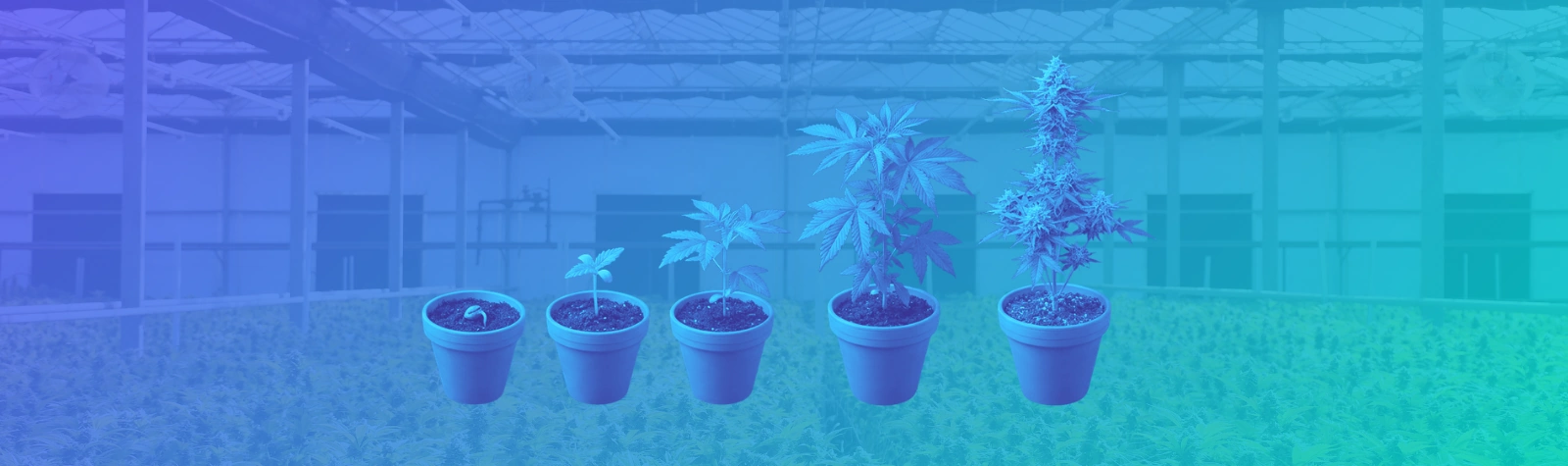
A cannabis crop goes through five distinct stages before it becomes a medicine:
🟣 germination,
🟣 seedling,
🟣 vegetative,
🟣 flowering
🟣 and harvest (with post-harvest drying and curing)
The whole cycle typically takes four to seven months for standard photoperiod cultivars, or as little as 10 to 14 weeks for auto-flowering ones. What separates a hobby grow from a European medical operation is not just what happens on the plant, but the GACP and EU-GMP paperwork that documents every step of the way.
Every gram of medical cannabis dispensed in Europe started as a single seed, or a cutting from a mother plant, in a controlled cultivation room somewhere in Portugal, Germany, the Netherlands, Denmark or a handful of other approved growing regions. The path from that seed to a labelled, pharmacy-shelf-ready product is one of the more disciplined agricultural processes in modern medicine.
If you have never worked on a cultivation floor, that path can feel opaque. There are people in white coats, LED walls, dehumidifiers, sticky labels on every surface, and someone with a clipboard asking about parts per million. If you understand the basic lifecycle underneath all that infrastructure, though, most of what a cultivator actually does starts making sense.
This is the fifth article in our Cannabis 101 series, a plain-English guide for professionals stepping into the European sector. In the previous article we looked at how sativa, indica, ruderalis, hybrids and cultivars actually differ; here we follow one of those cultivars from the day the seed cracks to the day the finished flower is packed away in a cured jar.
Germination (days 1–7)
Everything starts with a dormant cannabis seed. On the outside, it looks like a small brown-grey teardrop, roughly the size of a peppercorn, with faint tiger-stripe markings on healthy specimens. On the inside, it contains everything the plant needs to begin: an embryo, two small starter leaves called cotyledons folded neatly inside, and a food reserve to power the first few days of growth.
Germination is the process of waking that seed up. In practical terms it means giving it three things: moisture, warmth (around 21–25°C) and darkness. Within roughly 24 to 72 hours the seed absorbs water, the shell softens and cracks, and a small white taproot pushes downward, just as we described in Article 2 on plant anatomy. A day or two later, the seed itself rises with the stem as the cotyledons unfold above the surface. That is technically the moment the plant becomes a plant.
Cultivators typically germinate seeds in one of three ways:
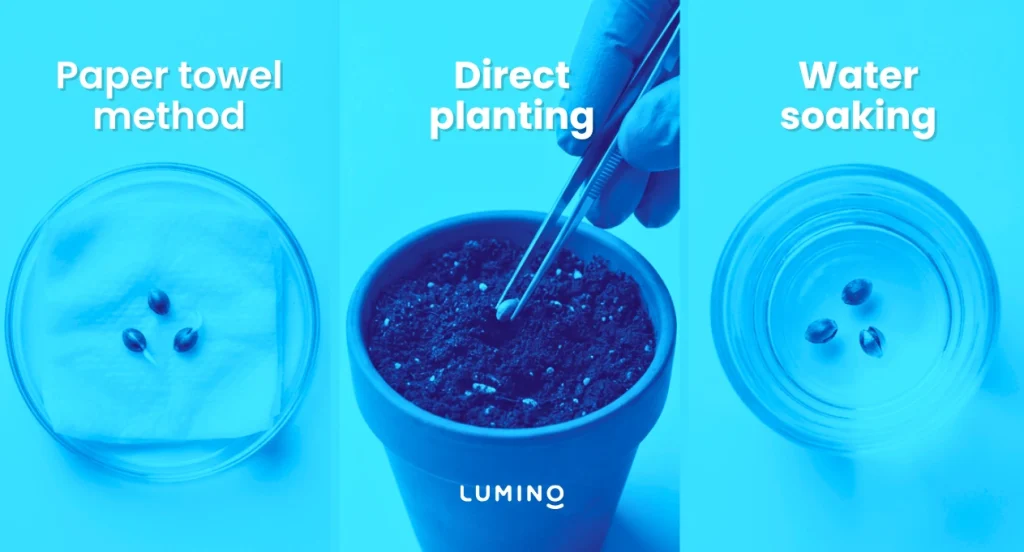
🟣 Paper towel method: the seed sits between two damp paper towels in a warm dark spot until the taproot emerges, then gets transferred to soil or a growing medium.
🟣 Direct planting: the seed goes straight into a small pot of pre-moistened soil or a plug of coco coir or rockwool.
🟣 Water soaking: the seed spends 12–24 hours in a glass of lukewarm water before being planted, which helps a stubborn shell soften.
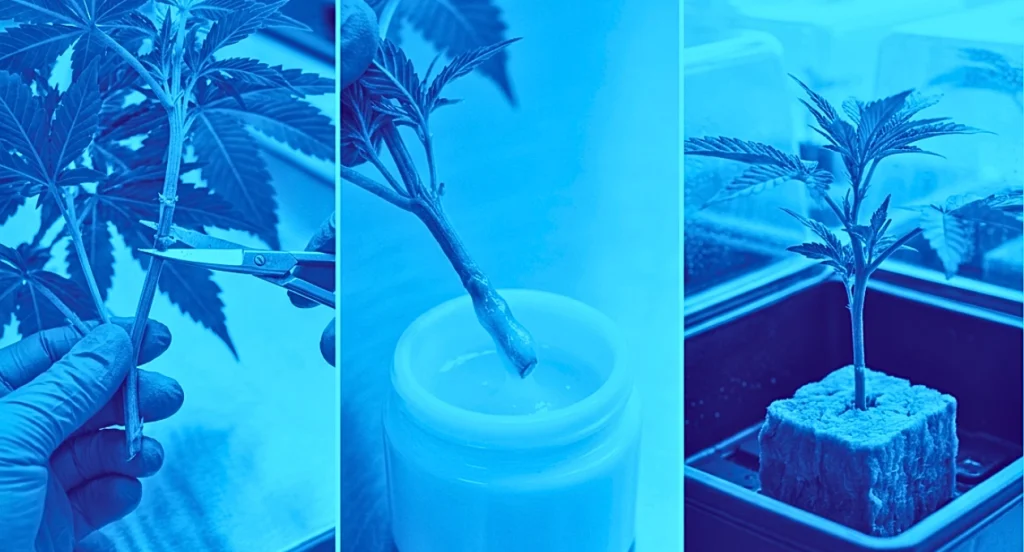
Cloned cannabis starts differently. A clone is a cutting from a mother plant, dipped in rooting hormone and coaxed to grow its own root system in a cube of rockwool or a small container. Clones skip the germination stage entirely, have no taproot, and are the preferred starting material for large-scale EU-GMP-compliant cultivation because they produce genetically identical plants, which is critical for reproducible medicine.
Germination looks small and unremarkable, but it is the point at which everything downstream is set: the plant’s genetic identity, its vigour, and, if a mistake is made here, its downstream cannabinoid content weeks later.
🌱 Fun fact:
A cannabis seed can stay viable for a surprisingly long time. Stored cool, dark and dry, good-quality seeds can germinate successfully after five years or more, and there are documented cases of seeds sprouting after a decade in storage. It is one of the reasons breeders can preserve genetic lines for future generations without freezing tissue.
Seedling stage (weeks 1–3)
Once the cotyledons are up and the plant is standing on its own, it enters the seedling stage. This is a delicate, roughly two- to three-week window where the plant is establishing its identity: growing its first real leaves, building out a real root system, and learning to feed itself through photosynthesis.
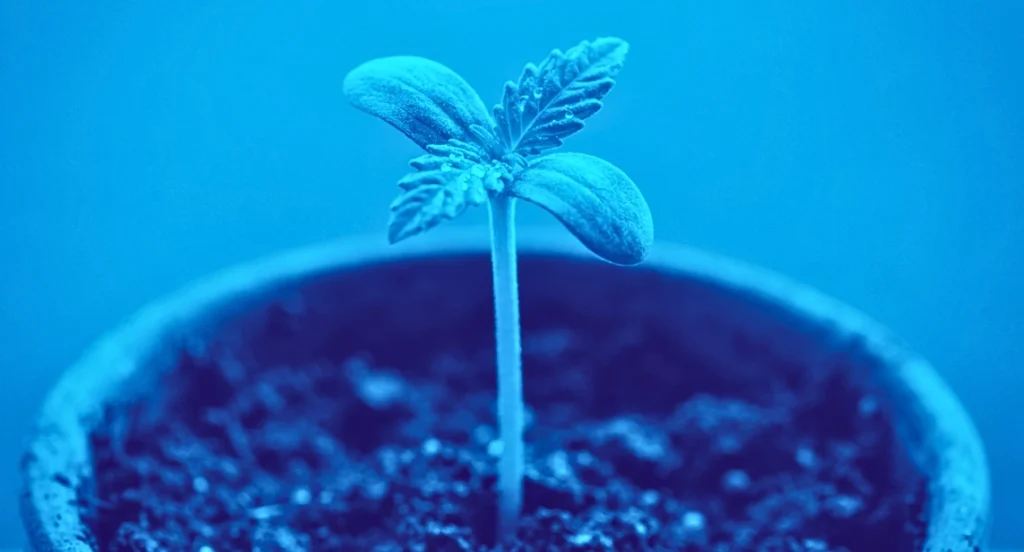
The visual signal that the seedling stage has begun is the appearance of the plant’s first true leaves just above the cotyledons. These usually have a single blade, followed shortly by a set with three blades, then five, then eventually the iconic seven-blade fan leaves (or more) we walked through in Article 2. It is one of the more visible expressions of the plant maturing week by week.
Underground, the taproot is pushing deeper and lateral roots are branching out, all while the plant is still small enough to easily damage. Cultivators are particularly cautious during this stage because seedlings are extremely sensitive to overwatering, overfeeding and light stress. Experienced cultivators would always say, more seedlings are killed by too much attention than by too little.
A typical medical-grade seedling setup looks something like this:
🟣 Light: around 18 hours on, 6 hours off, at low-to-moderate intensity (LED or T5 fluorescent).
🟣 Temperature: around 20–25°C.
🟣 Humidity: relatively high, around 65–70%, to compensate for the plant’s still-underdeveloped root system.
🟣 Water: small, careful amounts, letting the medium dry slightly between waterings.
🟣 Nutrients: minimal or none; the cotyledons and seed reserves feed the plant for most of this stage.
By the end of the seedling stage, a healthy plant will typically be 15 to 30 centimetres tall with several sets of true leaves, a visible sturdier stem, and enough of a root system to move it into a bigger pot. That transition is what triggers the next stage.
🌱 Fun fact:
The cotyledons that emerge from the seed are not “real” leaves at all. They are a pre-formed embryonic pair that were packed inside the seed from the start, and they do not resemble cannabis leaves in the slightest. Once the plant has grown enough true leaves to feed itself, the cotyledons simply yellow, wither and fall off, having done their job as the plant’s first battery pack.
Vegetative stage (weeks 3–10)
Once a seedling has settled into its bigger pot and its root system can support faster growth, the plant enters the vegetative stage. This is the phase most people picture when they think of a cannabis plant: fat green fan leaves, thickening stems, and week-on-week visible growth. It typically lasts anywhere from three to sixteen weeks, though most commercial European medical operations run it for around four to eight.
The plant is not producing any flowers yet, and it is not producing any meaningful cannabinoids. What it is doing is building the framework that will eventually carry the flowers. Every extra week in vegetative growth means a bigger plant with more branches, more nodes, more leaves and, ultimately, more sites for flowers to form once the plant switches into the next stage.
The key operational fact about the vegetative stage is that it is controlled by light. A standard photoperiod cannabis plant will keep growing vegetatively indefinitely, as long as it receives more than about 14 hours of light per day. Most cultivators run 18 hours of light and 6 hours of dark, or sometimes 24 hours of continuous light, during this phase. Auto-flowering cultivars ignore this rule and switch into flowering on their own internal schedule after about three to four weeks, which is why (as we covered in Article 4) they compress the whole cycle so dramatically.
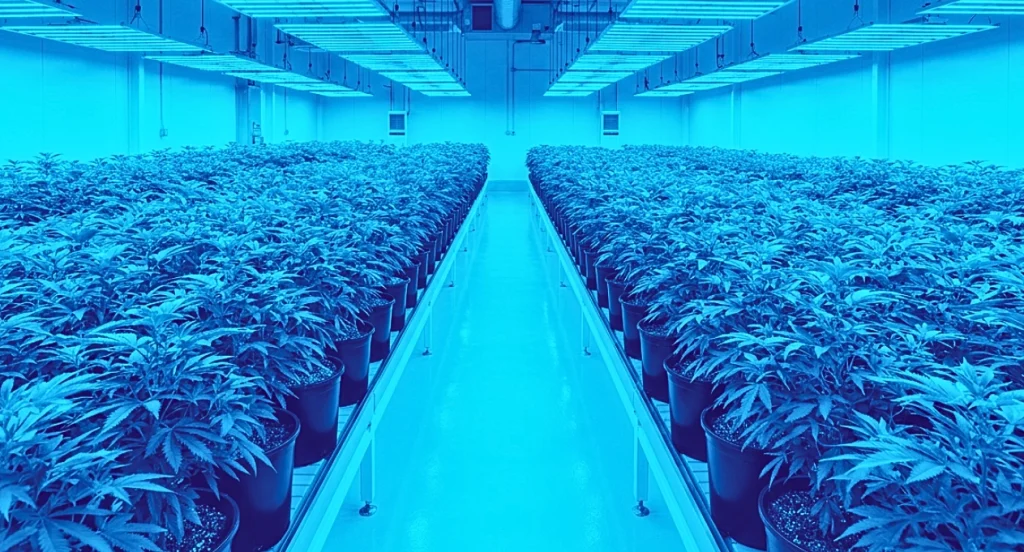
A typical vegetative-stage setup for European medical cultivation looks something like this:
🟣 Light: 18 hours on, 6 hours off, at moderate-to-high intensity.
🟣 Temperature: around 22–28°C during lights-on, cooler during lights-off.
🟣 Humidity: moderate, around 55–70%, dropping as the plant matures.
🟣 Water: steadily increasing volumes as the root system expands.
🟣 Nutrients: a nitrogen-rich feed to support fast leaf and stem growth.
This is also the stage where cultivators do most of their plant training: techniques such as topping (cutting the main stem to encourage bushier growth), low-stress training (bending branches to open up the canopy), pruning away lower growth that will never receive enough light to produce quality flower, and installing the first layer of trellis netting (often called the SCROG, or Screen of Green) horizontally across the canopy to spread branches out and force an even, flat growing surface. Well-trained plants produce more evenly-sized flowers across the whole canopy, which is exactly what a GACP and EU-GMP environment needs for batch consistency.
Toward the end of the vegetative stage, cultivators are also sexing their plants (if grown from regular rather than feminised seeds), inspecting each plant for the earliest signs of male pollen sacs, and removing any males from the room before the flowering stage begins. Get that step wrong and, as we covered in Article 2, a single accidental male can pollinate a whole crop and destroy weeks of work.
🌱 Fun fact:
In ideal conditions, a healthy cannabis plant in vegetative stage can grow as much as five centimetres per day, roughly two inches. It is one of the fastest-growing herbaceous plants used commercially, which is part of why the crop is agriculturally attractive: yield per square metre per year is unusually high compared to most medicinal herbs.
Flowering stage (weeks 8–20)
This is the stage everyone is really waiting for. The flowering stage is when the plant stops focusing on green growth and starts producing the resinous buds that will eventually become medicine. Depending on the cultivar, it takes anywhere from six to twelve weeks from the moment it begins.
For a photoperiod cannabis plant, flowering is triggered by a change in the light schedule. Cultivators flip their lighting from 18 hours on / 6 hours off down to 12 hours on / 12 hours off. That extended dark period mimics the shortening days of late summer, which is the natural signal a cannabis plant evolved to interpret as “autumn is coming, time to reproduce”. Within days of the switch, the plant starts putting its energy into producing flowers instead of leaves. Auto-flowering cultivars, again, ignore all of this and flower on their own biological clock.
The flowering stage itself unfolds in three loose phases:
🟣 Weeks 1–3 (pre-flower / stretch): the plant undergoes a dramatic growth spurt, often doubling in height in the first two weeks, before slowing again. The first small white pistils (see Article 2) begin emerging from the nodes. Cultivators often add a second (and later a third) layer of trellis netting above the first during this window, to support the increasingly heavy developing flowers as they grow upward through the canopy.
🟣 Weeks 3–6 (mid-flower): the flowers develop mass. Small pistil clusters thicken into recognisable buds. Trichomes begin appearing in visible numbers on the bracts and sugar leaves, giving the buds their first frosty appearance. Aromas start to intensify as terpene production ramps up.
🟣 Weeks 6–12 (late-flower / ripening): the flowers reach their final size and density. Pistils shift colour from white to yellow to orange to red-brown, and trichome heads change from clear to milky-white to amber. This is the window where a cultivator, watching a microscope aimed at those trichomes, decides exactly when to harvest.
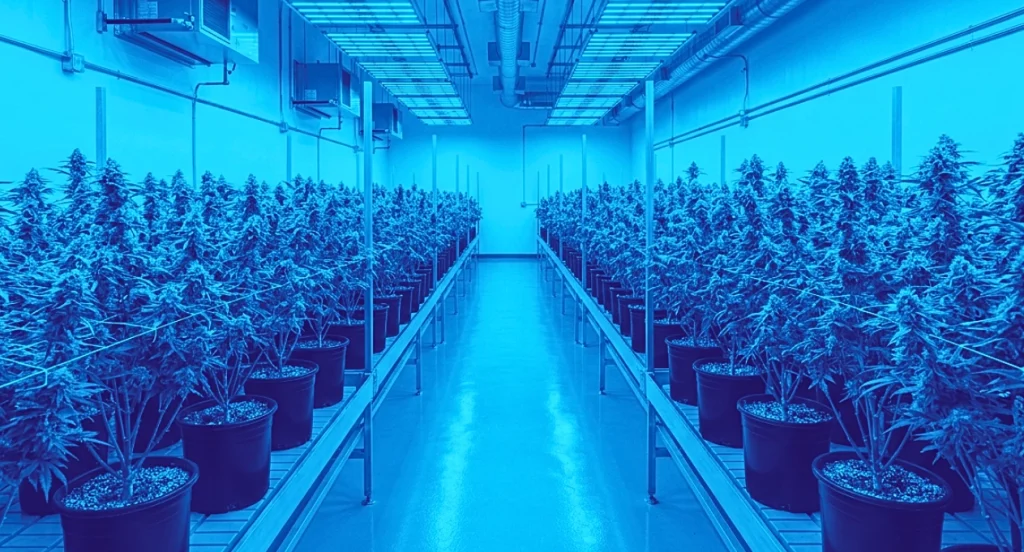
A typical late-vegetative-into-flowering setup for European medical cultivation shifts as follows:
🟣 Light: 12 hours on, 12 hours off, at high intensity.
🟣 Temperature: slightly cooler than veg, around 20–26°C during lights-on, dropping to 18–20°C during lights-off to encourage resin production and colour development.
🟣 Humidity: deliberately lower, around 40–50%, to reduce the risk of bud rot (Botrytis) in dense mature flowers.
🟣 Water: steady, matched to the plant’s larger size.
🟣 Nutrients: the feed switches from nitrogen-rich (for leaf growth) to phosphorus- and potassium-rich (for flower production), with a “flush” of plain water in the final week or two to remove residual nutrient salts from the plant tissue.
This is also the stage where hermaphroditism (as we covered in Article 2) becomes a real risk. Environmental stress at this point, sudden temperature swings, light leaks during the dark period, physical damage, can push a female plant to produce a few male flowers on her own tissue and self-pollinate the room. A well-run medical grow environment is almost paranoid about consistency during flowering, precisely for this reason.
🌱 Fun fact:
The cannabis flowering stretch in the first two weeks is one of the fastest growth spurts in commercial horticulture. In extreme cases, some sativa-dominant cultivars can nearly triple in height between the light flip and the end of week three, which is why indoor cultivators plan their canopy height around the finished plant, not the plant they see on the day they trigger flowering.
Harvest, drying and curing (weeks 12–20+)
When the flowers are ripe (trichomes mostly milky-white with a scatter of amber, pistils curled and darkened, aromas at peak intensity), the plant has done its job. Everything from here on is about preserving what the plant produced.
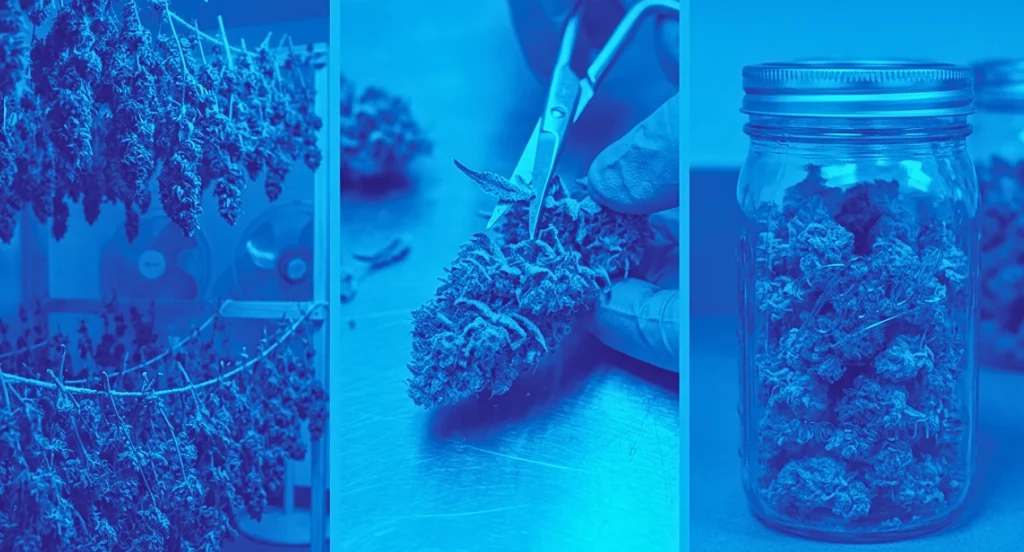
The harvest itself takes a single day for a well-organised medical grow. Plants are cut at the base, hung upside down or trimmed on-site depending on the operation’s preferred method, and moved into a controlled drying room. In a European medical setting this is not a garage or a shed. It is a room with tight environmental controls, typically held at around 18–20°C and 55–60% relative humidity, with slow air circulation and full darkness. The goal is to remove moisture from the flowers slowly enough to preserve terpenes and cannabinoids, but quickly enough to stop mould before it starts.
Drying typically takes seven to fourteen days. Move too fast and you strip out the terpenes; move too slow and you invite bud rot (Botrytis) or other microbial contamination that will fail a GACP or EU-GMP batch release. A cultivator judges the flowers “dry enough” when the small stems inside the buds snap cleanly rather than bending.
Once dried, the flowers move into curing. This is the underappreciated step that separates good cannabis from great cannabis. Cured flower is sealed into airtight containers (traditionally glass jars, industrially food-grade barrels or nitrogen-flushed pouches) at around 62% humidity for anywhere from two to eight weeks, with the containers briefly opened every day or two to release built-up moisture and gases. During curing:
🟣 Residual chlorophyll breaks down, softening the “hay-like” taste of freshly dried flower.
🟣 Cannabinoids continue to convert into their fully active forms.
🟣 Terpene profiles round out and deepen, producing the full aromatic character that will eventually reach the patient.
Only after curing does the flower become the finished product a European pharmacy or clinic will actually dispense. That finished flower then goes through trimming (removing the sugar leaves for extract production and cleaning up the bud shape), quality control testing (a topic we cover later in this series in Article 8) and packaging and labelling under EU-GMP rules before it leaves the facility.
From the moment the seed cracked to the moment the cured flower is packaged, a standard photoperiod medical crop has been in someone’s care for roughly four to seven months. An auto-flowering crop can compress that to about three months. Both are long enough that every decision along the way (germination method, veg length, light schedule, harvest timing, cure length) shows up in the finished product.
🌱 Fun fact:
Research shows the flavour and aroma changes of a cure are not just perceived quality: they are measurable chemistry. A study by Eybna Technologies found that after just one week of curing, the dominant terpene myrcene can drop by around 55%, while heavier sesquiterpenes like caryophyllene and humulene actually increase. Most cultivators find the greatest quality gains happen between roughly weeks 2 and 6 of cure, though dense indica-heavy cultivars often benefit from 6–8 weeks and high-terpene flowers can keep improving out to 12 weeks. A 2024 peer-reviewed study on controlled-atmosphere drying has since started to compress this whole cycle without losing terpene content, an early sign that the science of curing is only just catching up with the art.
Why the cultivation lifecycle matters to jobs in the European cannabis industry
Every stage of the lifecycle we have walked through maps onto a specific job, decision or document in the modern European medical sector:
🟣 Cultivators and grow managers live inside this timeline. Their entire calendar is built around germination dates, veg-to-flip windows, expected harvest weeks and cure schedules, and their KPIs (yield per square metre, cannabinoid consistency, batch fail rate) are all downstream of the choices they make at each stage.
🟣 Facility engineers and controlled-environment specialists design and maintain the rooms these stages take place in: LED and HPS lighting rigs, HVAC systems, dehumidifiers, air-flow layouts, drying and curing rooms. In an EU-GMP context, every one of those systems needs a documented specification, a validation protocol and a maintenance log.
🟣 Quality assurance and regulatory professionals are the ones stitching all of this into a compliance narrative. GACP governs everything up to and including drying; EU-GMP takes over from post-drying processing through to final release. Understanding which standard applies at which stage is essential for anyone writing SOPs, hosting inspections or preparing a batch record.
🟣 Extraction and processing teams take their inputs directly from post-cure flower and trim, so they care deeply about how a crop was dried and cured. Poorly cured input material produces harsher, less flavourful and less potent extracts, and no downstream processing can fully fix it.
🟣 Pharmacists and prescribers rarely see the cultivation floor, but the reproducibility of the lifecycle is what makes their prescriptions reliable. A patient stabilised on a specific cultivar at a specific chemovar depends on the grower being able to hit that same profile crop after crop, month after month.
The point is that a European medical cannabis operation is not just a farm. It is a pharmaceutical manufacturing process that happens to start with a living plant. The lifecycle we have described is the shared timeline that every function in the business, from cultivation to compliance to prescribing, is quietly working around.
In the next articles in our Cannabis 101 series we take the cured flower off the shelf and follow it further downstream: into the different products and consumption methods it becomes, the extraction methods used to turn it into oils, resins and vapes, and finally into the quality systems (EU-GMP, GACP and lab testing) that turn all of it into a regulated European medicine.
Frequently asked questions
How long does it take to grow a cannabis plant?
A standard photoperiod medical cannabis plant takes roughly four to seven months from seed to cured flower: about a week of germination, two to three weeks as a seedling, three to sixteen weeks of vegetative growth (most European medical operations run four to eight), six to twelve weeks of flowering, then one to two weeks of drying and two to eight weeks of curing. Auto-flowering cultivars can compress the whole cycle to about ten to fourteen weeks.
What are the stages of the cannabis lifecycle?
Five: germination, seedling, vegetative, flowering and harvest / post-harvest (drying and curing). Each stage has its own environmental requirements (light, temperature, humidity, water, nutrients) and its own cultivation goals.
What triggers cannabis to flower?
For photoperiod cultivars, flowering is triggered by a shift in the light schedule from around 18 hours on / 6 hours off during vegetative growth to 12 hours on / 12 hours off. The extended dark period mimics late-summer day-length and signals the plant to switch from green growth to reproductive flowering. Auto-flowering cultivars ignore this and flower on their own internal schedule after about three to four weeks.
Why is curing so important?
Curing is what turns freshly-dried flower into a stable, aromatic, fully-active finished product. During curing, residual chlorophyll breaks down (softening the raw grassy taste), cannabinoids stabilise, and the terpene profile rounds out. Research shows measurable chemical changes across the first six to twelve weeks of cure. Skipping or shortening this step produces harsher, less flavourful and often less potent finished flower.
What is the difference between GACP and EU-GMP?
GACP (Good Agricultural and Collection Practice) governs the cultivation, harvest and initial post-harvest handling of medical cannabis, up to and including drying. EU-GMP (European Union Good Manufacturing Practice) takes over from post-drying processing through to final release, and is required for any cannabis product sold through a European pharmacy. Serious medical operators are certified under both.
References
- The life cycle of cannabis: from seed to harvest (Sensi Seeds)
- Typical cannabis growth timeline: from seed to harvest (FloraFlex)
- The cannabis life cycle in weeks (ILGM)
- The cannabis plant life cycle: stages week by week (Grow with Jane)
- EU-GMP certification for cannabis: the complete 2026 guide (GrowerIQ)
- Researchers reveal how curing cannabis affects terpene levels (Ganjapreneur, on Eybna Technologies study)
- How to cure cannabis: drying and curing for maximum quality (Athena Ag)
- In pursuit of optimal quality: cultivar-specific drying approaches for medicinal cannabis (PMC, 2024)
- Cannabis plant anatomy: a field guide from roots to trichomes (Lumino, Cannabis 101, Article 2)
- Sativa, indica, ruderalis and hybrids: the cannabis taxonomy debate (Lumino, Cannabis 101, Article 4)


 English (UK)
 Deutsch